
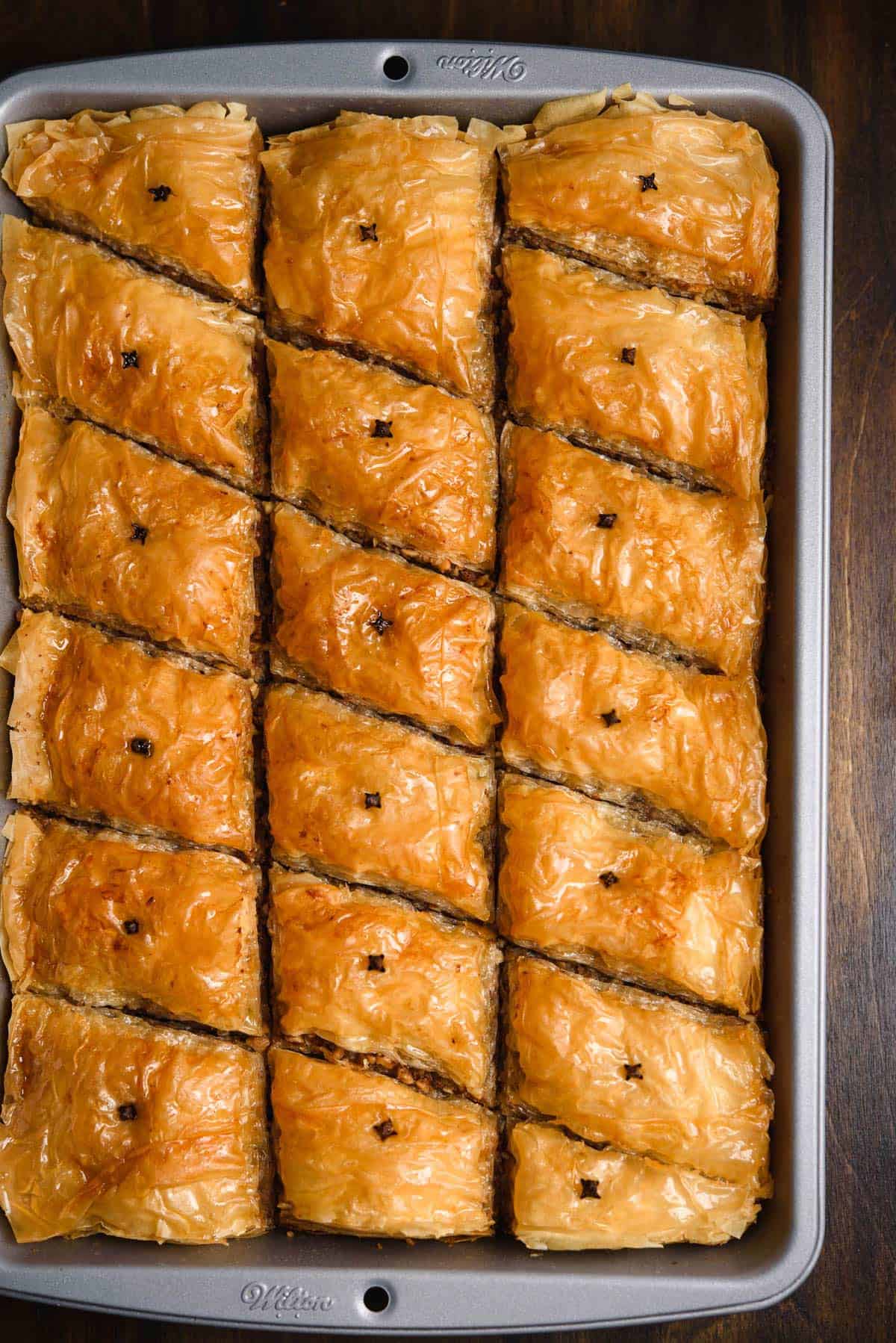
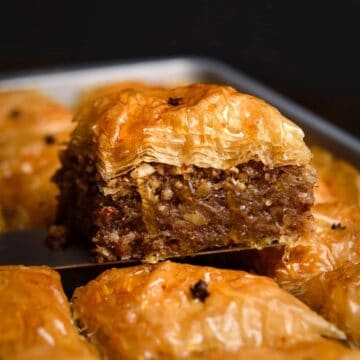
This Greek Baklava recipe features a crispy, golden pastry, dripping with sweet honey syrup, and an aromatic filling of ground almonds and walnuts lightly spiced with cinnamon and cloves.

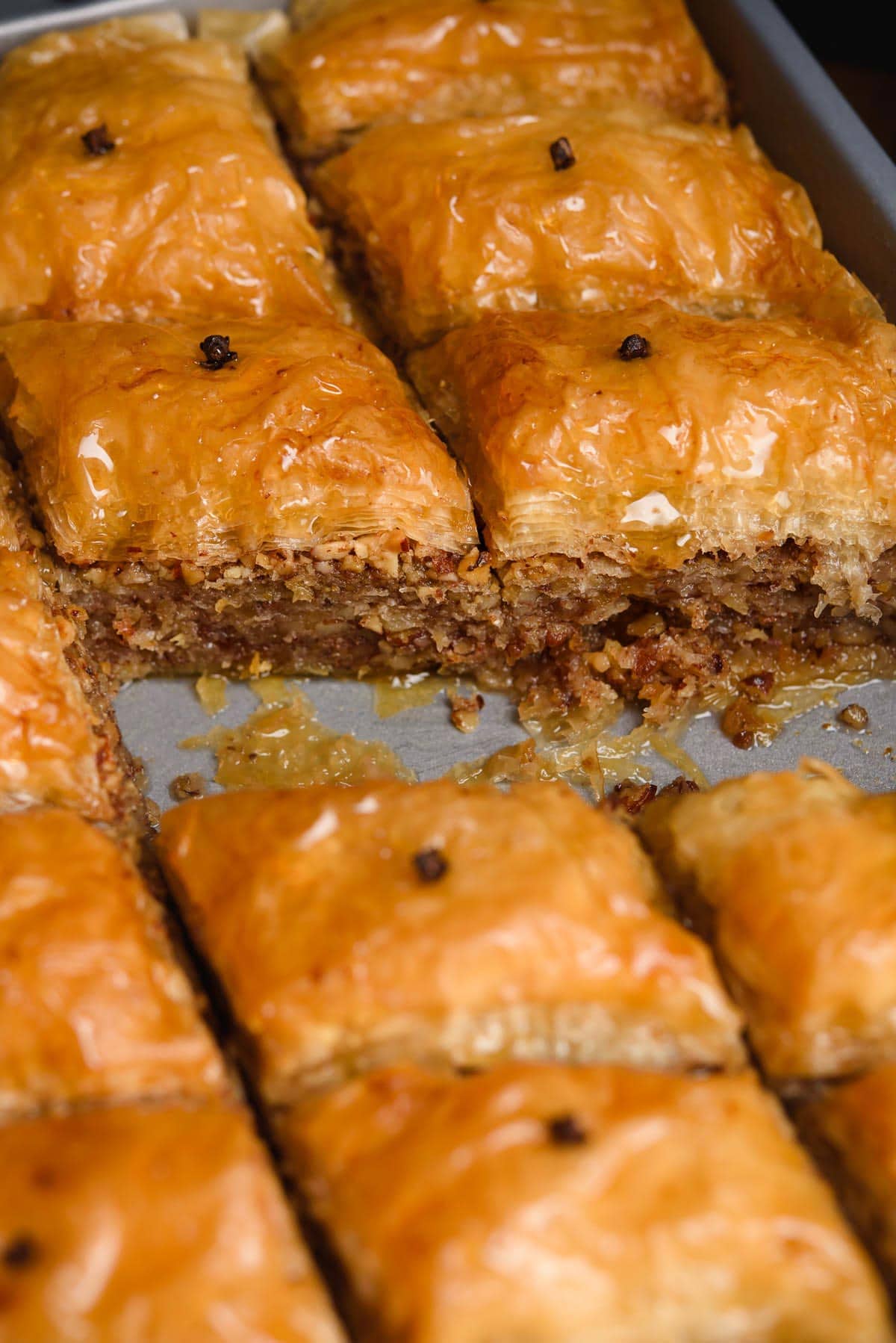
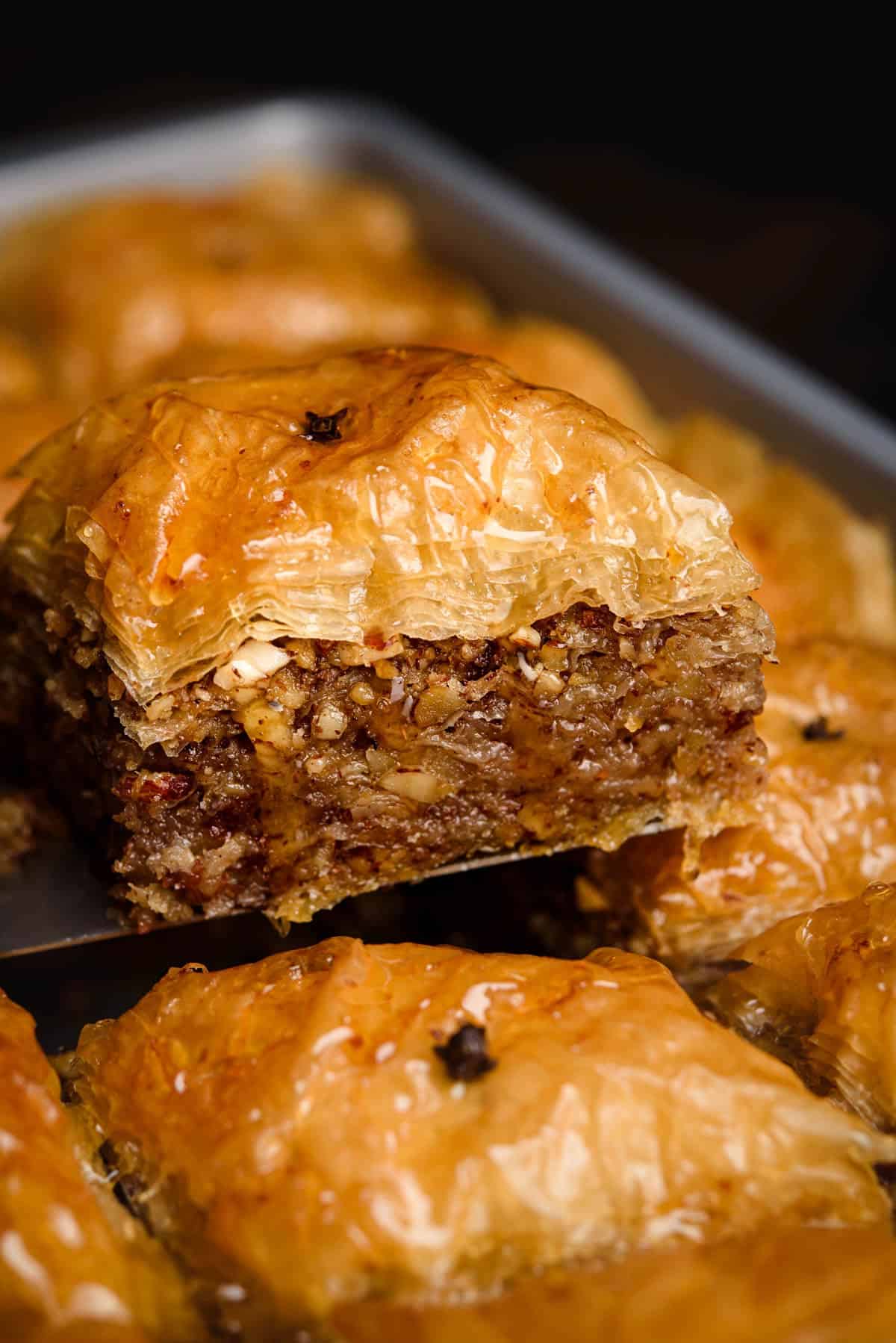
An Authentic Greek Baklava is a crunchy phyllo pastry dessert soaked in syrup. It's very crispy and flaky on top, with softer, syrup-drenched middle layers filled with crunchy chopped nuts.
Table Of Contents
Greek Baklava vs Turkish Baklava
There are a few minor differences between Greek and Turkish Baklava. For one, it's the nuts used in the filling. For Greeks, it's usually walnuts or almonds (or a mixture of both), while for Turks, their traditional Baklava is made with pistachios.
The second difference is in the syrup: Greek Baklava syrup usually contains honey and cinnamon, or even cloves. While the Turkish version is plain sugar syrup with some lemon.
Thirdly, for brushing the phyllo, Greeks use melted butter, often mixed with olive oil, while Turks traditionally use clarified butter. And lastly, a Greek Baklava is always flavoured with spices like cinnamon and cloves, while Turkish Baklava doesn't contain any spices.
Greek Baklava Types
In addition to the traditional Greek Baklava recipe, there are many versions of this favourite dessert in Greece. Some of which adapt elements from Eastern countries, like the Turkish Baklava mentioned above.
So you can find pistachio Baklava or Walnut Baklava, or other modern variations such as Cheesecake Baklava, Mini Baklavas, Chocolate Baklava, or Baklava Rolls.
Baklava Ingredients
- Phyllo dough: phyllo or filo pastry dough that comes in 1-pound (450-gram packages). You need about 1½ packages for this recipe. The number of phyllo sheets each package contains may vary depending on the label, so it's better to calculate the phyllo you need by weight.
- Raw Nuts: I use a mixture of half walnuts and half almonds. You can use just walnuts, just almonds, or other nuts if you prefer, such as pistachios, pecans, or even hazelnuts.
- Butter: melted butter, you can also use clarified butter if you prefer.
- Olive Oil: mixed with melted butter to brush the phyllo. You can use a lighter vegetable oil instead, such as sunflower or corn oil, or skip oil altogether and use only butter.
- Spices: ground cinnamon and ground cloves.
- Breadcrumbs: a small amount is added to the filling. This is done a lot in old-fashioned Greek Baklava recipes to add body to the filling and hold the syrup better in between the layers.
- Sugar: white sugar to make the syrup.
- Honey: to make the syrup and drizzle over the Baklava when serving.
- Cinnamon Stick: to flavour the syrup. You may also use a lemon or orange peel for an extra citrusy aroma.
- Lemon Juice: We add this to the syrup to prevent crystallisation.
- Cloves: traditional Greek Baklava is decorated with a piece of clove in the centre of each piece. Of course, you can always skip this!
How To Make
To make Greek Baklava, first cut the phyllo in half to fit the pan. For this recipe, I'm using a 9 x 13-inch (23 x 33 cm) pan (affiliate link).
Prepare the filling by combining finely chopped nuts, sugar, breadcrumbs, and ground spices (cinnamon and cloves). Also, combine the melted butter with olive oil for brushing the phyllo.
And now it's time to start making layers. For the bottom, add 6 phyllo sheets to the pan. Brushing with plenty of the butter-oil mixture every second phyllo you add. Then add a layer of the filling. About 3-4 tablespoons.
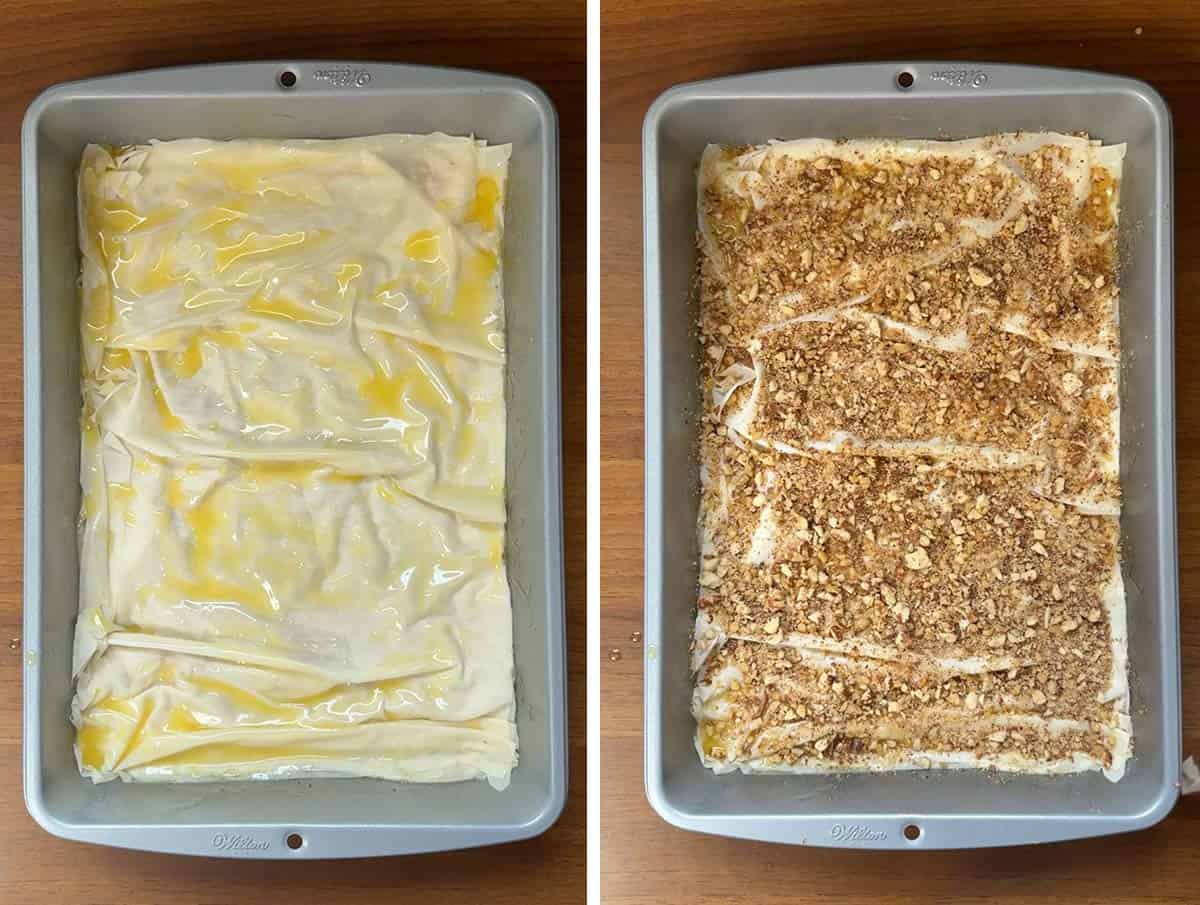
For the middle layers of the Baklava, add 2 phyllo sheets and one layer of filling. Repeat until you use all of the filling, and you're left with 8-10 sheets of phyllo to use for the top.
The top of the Baklava is just like the bottom, without layers of nuts in between, just layers of phyllo. Add the phyllo sheets 2 by 2 with plenty of butter in between.
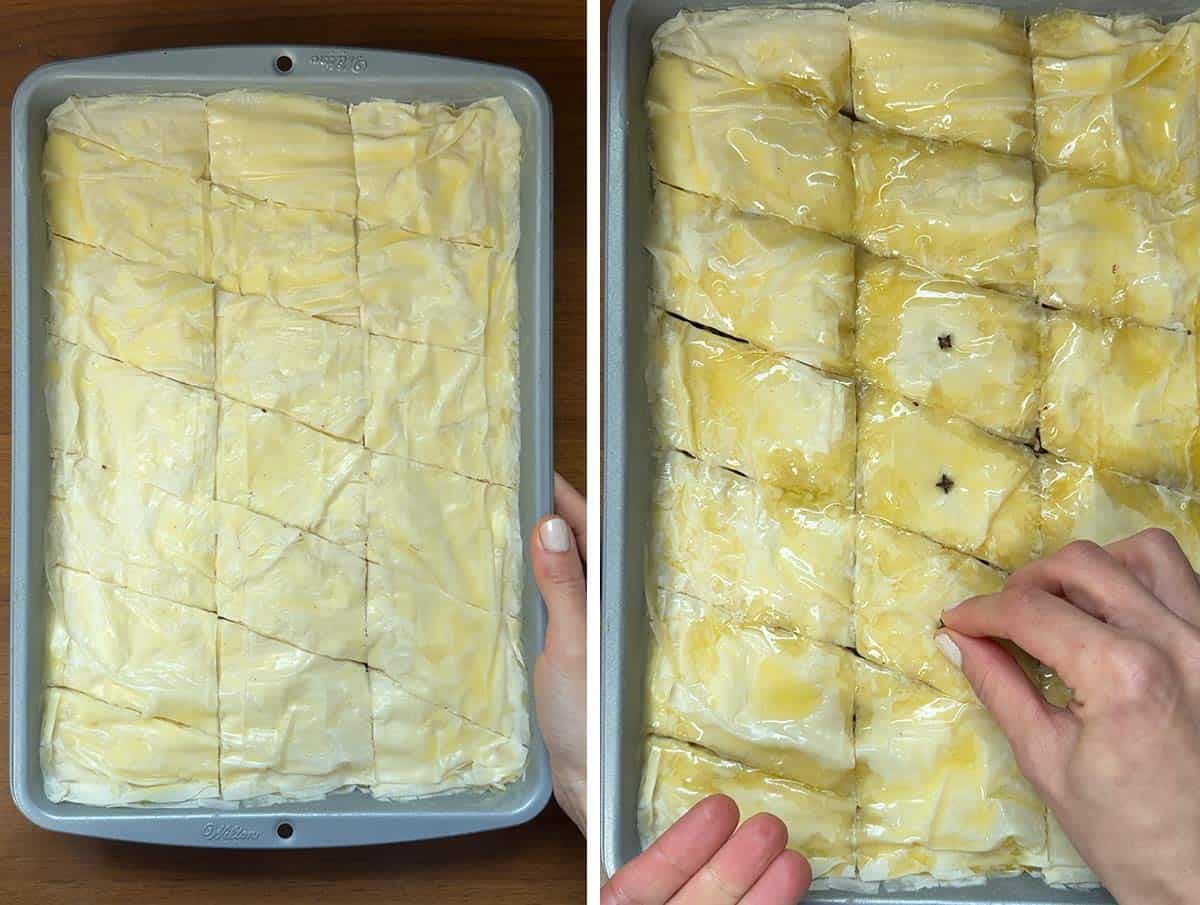
Finally, cut and divide the Baklava pastry into pieces, pour the remaining butter on top, and decorate each piece with a clove.
Baking
Baklava bakes low and slow at 150°C / 300°F for about an hour and a half. In order to become perfectly golden and crispy. It's also best to cook it on a lower rack, so it won't colour on top too soon.
Adding Syrup
To add syrup to Baklava, both the Baklava and the syrup need to be hot. So, prepare the syrup 20 minutes before you finish baking the pastry.
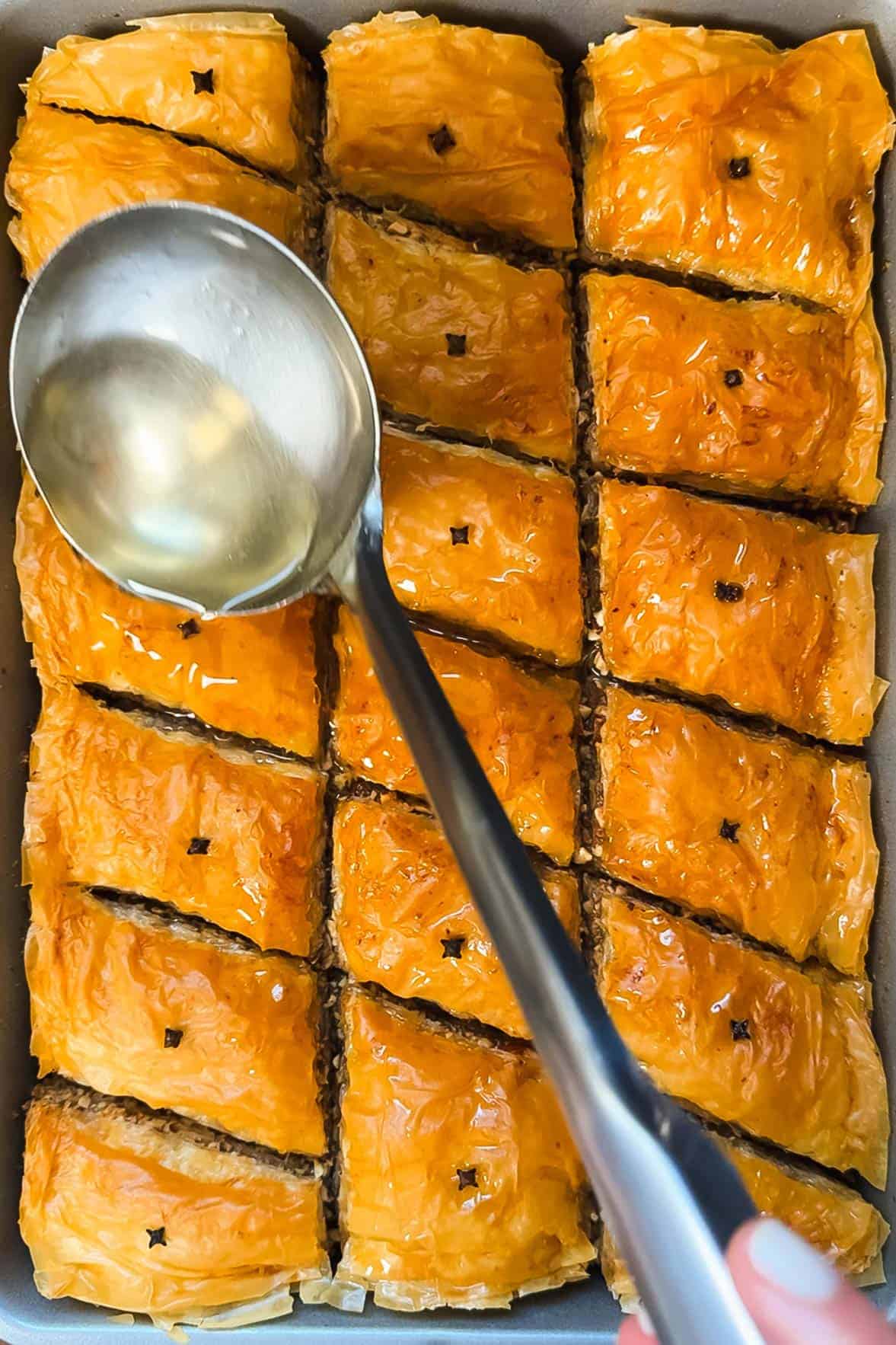
And add the syrup to the Baklava as soon as you take it out of the oven. Use a ladle and add a spoonful at a time, waiting a few seconds for each spoonful to absorb.
TIPS
- Finely chop the nuts, but don't powder them; they should have a bite.
- Cover the phyllo with a tea towel as you work because it air-dries.
- Don't stir the syrup from the moment it starts to boil because it might crystallise.
- Always boil a syrup in a narrower, taller cooking pot than a wide one. This gives space at the top for the syrup to bubble without spilling out of the pot. Also, sugar dissolves better. Ideally, the syrup should fill the pot to half its height.
- Bake the Baklava on a lower oven rack so it won't colour too soon on top. In the final minutes of baking, if it's not honey-browned on top, you can transfer it to one of the top racks.
Serve With
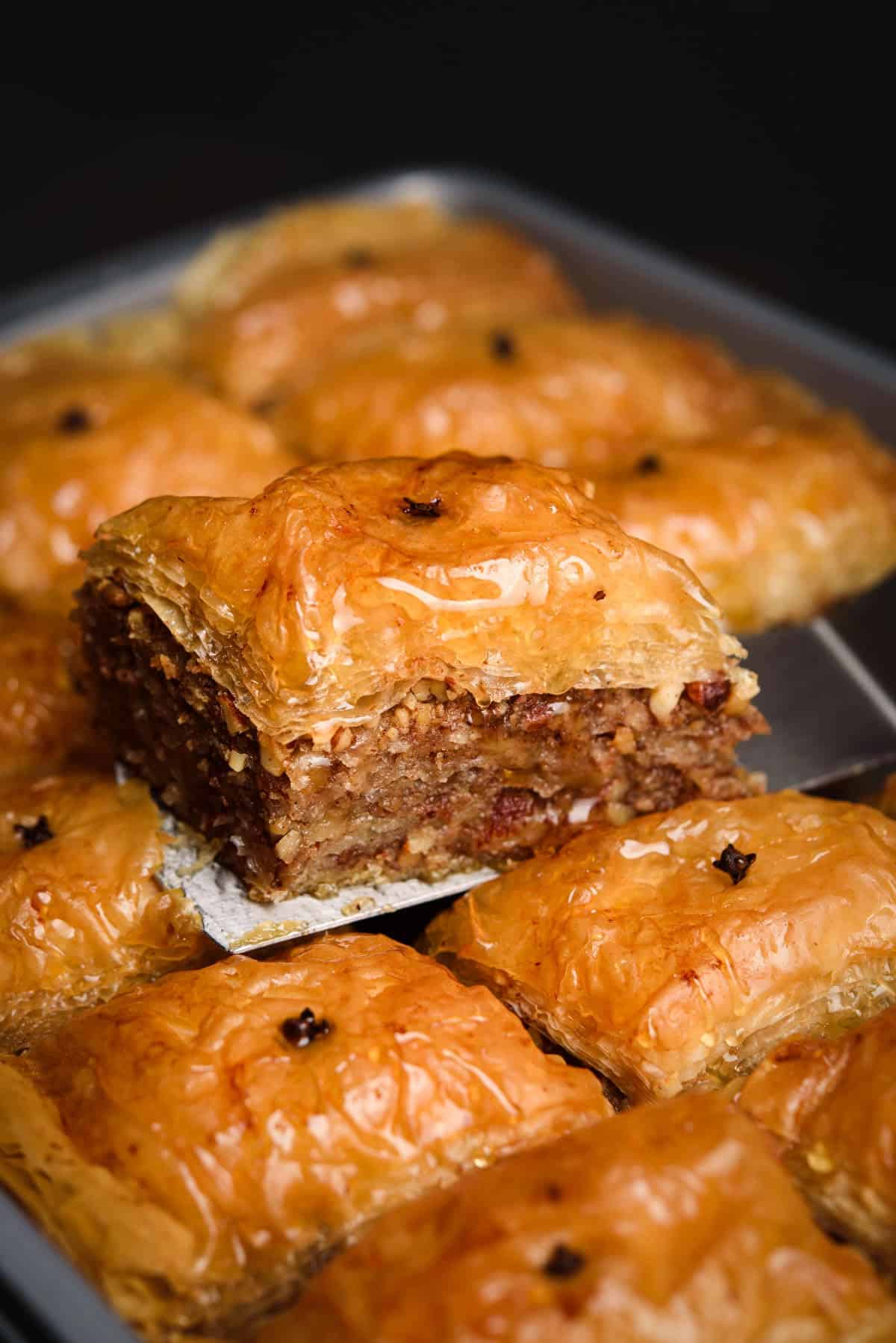
Serve this classic Baklava pastry with a drizzle of raw honey on top. Thyme honey or flower honey is best. Another favourite way of serving Baklava is with a scoop of vanilla ice cream.
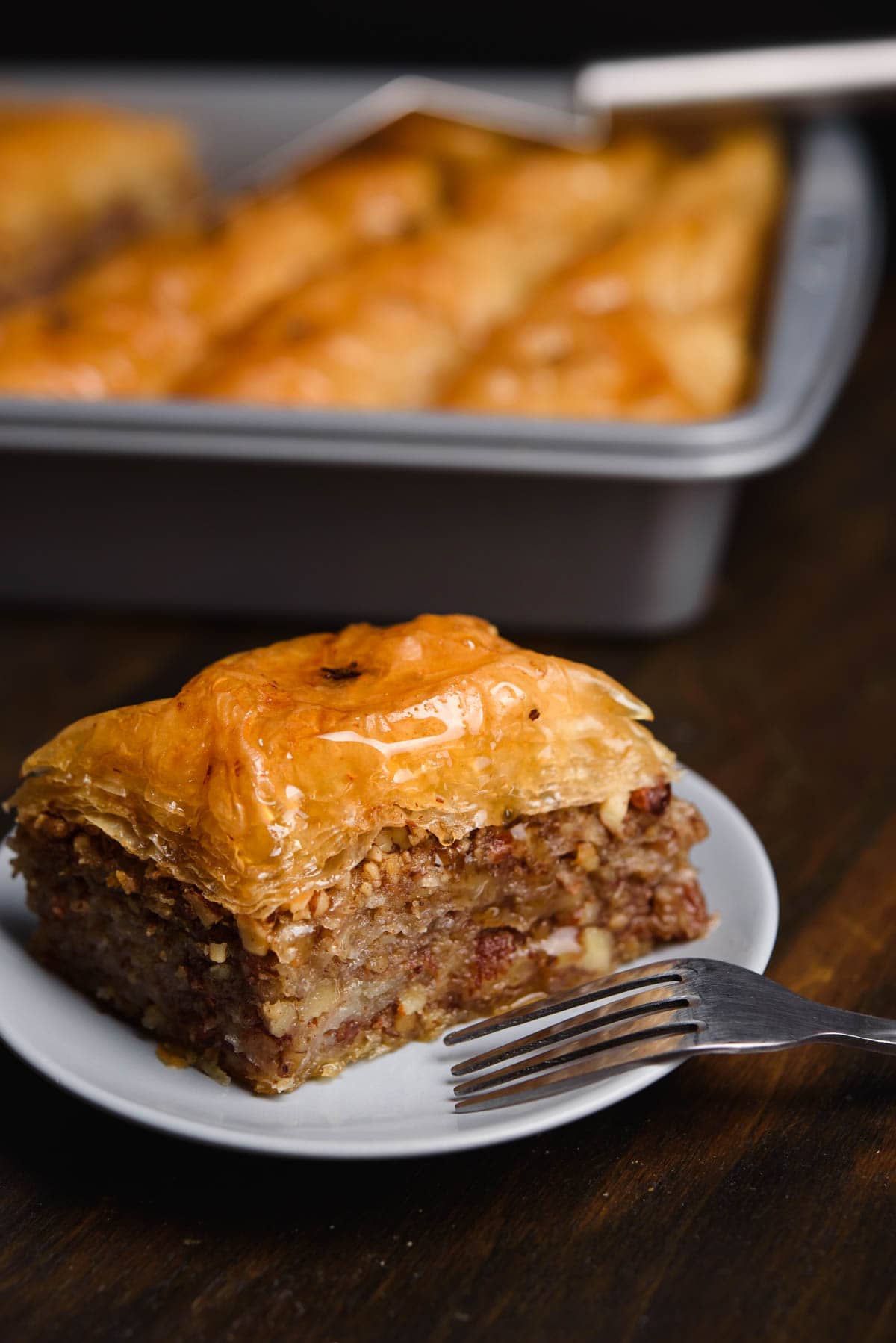
If you want something more traditional Greek, try serving Baklava with Kaimaki ice cream with Mastiha (it's such a tasty combination that I can't find words to describe it!).
Recipe
Authentic Greek Baklava
Ingredients
For The Baklava Pastry:
- 650 grams (1.4 pounds) phyllo dough (about 1½ package)
- 270 grams (9.5 ounces) almonds
- 270 grams (9.5 ounces) walnuts
- 2 tablespoons ground breadcrumbs
- 2 tablespoons sugar
- 1½ teaspoon ground cinnamon
- ⅓ teaspoon ground cloves
- 350 grams (12.3 ounces) butter melted
- 200 ml olive oil
- OPTIONAL whole cloves to decorate on top
For The Baklava Syrup:
- 450 grams (2 + ¼ cups) sugar
- 500 ml (2 cups) water
- 100 grams (3.5 ounces) honey + extra to drizzle on top
- 2 tablespoons fresh lemon juice
- 1 stick of cinnamon
Instructions
- Thaw phyllo in the fridge overnight, then leave it at room temperature for about an hour, unopened, within its package.
- Preheat the oven to 150°C / 300°F.
- Finely chop the nuts. Use a food processor and pulse the almonds and walnuts until finely chopped.
- Make the filling. Mix the chopped nuts with the breadcrumbs, 2 tablespoons of sugar, ground cinnamon, and ground cloves.
- Cut the phyllo in half so the sheets fit inside a 9 x 13-inch (23 x 33 cm) pan. Cover with a tea towel so it won't air-dry.-See Notes Below.
- Combine melted butter with olive oil.
- Brush the bottom of the pan generously with the butter-oil mixture.
- Add 6 phyllo sheets at the bottom. Begin with 2 phyllos, brush with butter, add 2 more, and repeat.
- Sprinkle 3-4 tablespoons of the filling.
- Add 2 more phyllo sheets and brush with butter. Repeat making layers until you use up all the filling.
- Top with 8-10 phyllo sheets, brushing them with butter in between.
- Cut the Baklava into pieces. Cut into 3 long strips (lengthwise) first, then cut diagonally to form diamond shapes. Cut all the way through to the bottom of the pan.
- Pour the remaining melted butter on top.
- Decorate with cloves (optional). Press a whole clove to the center of each piece.
- Bake for about 1 hour and 30 minutes in the lower rack of the oven. Until the pastry turns honey-golden in color and becomes very crispy.
Make The Syrup:
- Begin making the syrup 20 minutes before removing the Baklava from the oven.
- Add sugar, honey, water, cinnamon stick, and lemon juice to a small cooking pot or large saucepan. -See Notes Below.
- Bring to a boil, then cook for 6-7 minutes (time counts from the moment it starts to bubble hard).
- Ladle the hot syrup over the hot Baklava as soon as you get it out of the oven.
- Let the Baklava cool to room temperature, then serve or transfer it to the fridge (ideally) for the syrup to cool and set. It tastes even better the next day!
- Serve drizzled with raw honey.

This was delicious! Took it to a Greek party and received many compliments. This was my first attempt at baklava, and although it was time consuming, it wasn't overly difficult.